Avesh Khan Quietly Rewrites the Role of a Finisher in IPL History
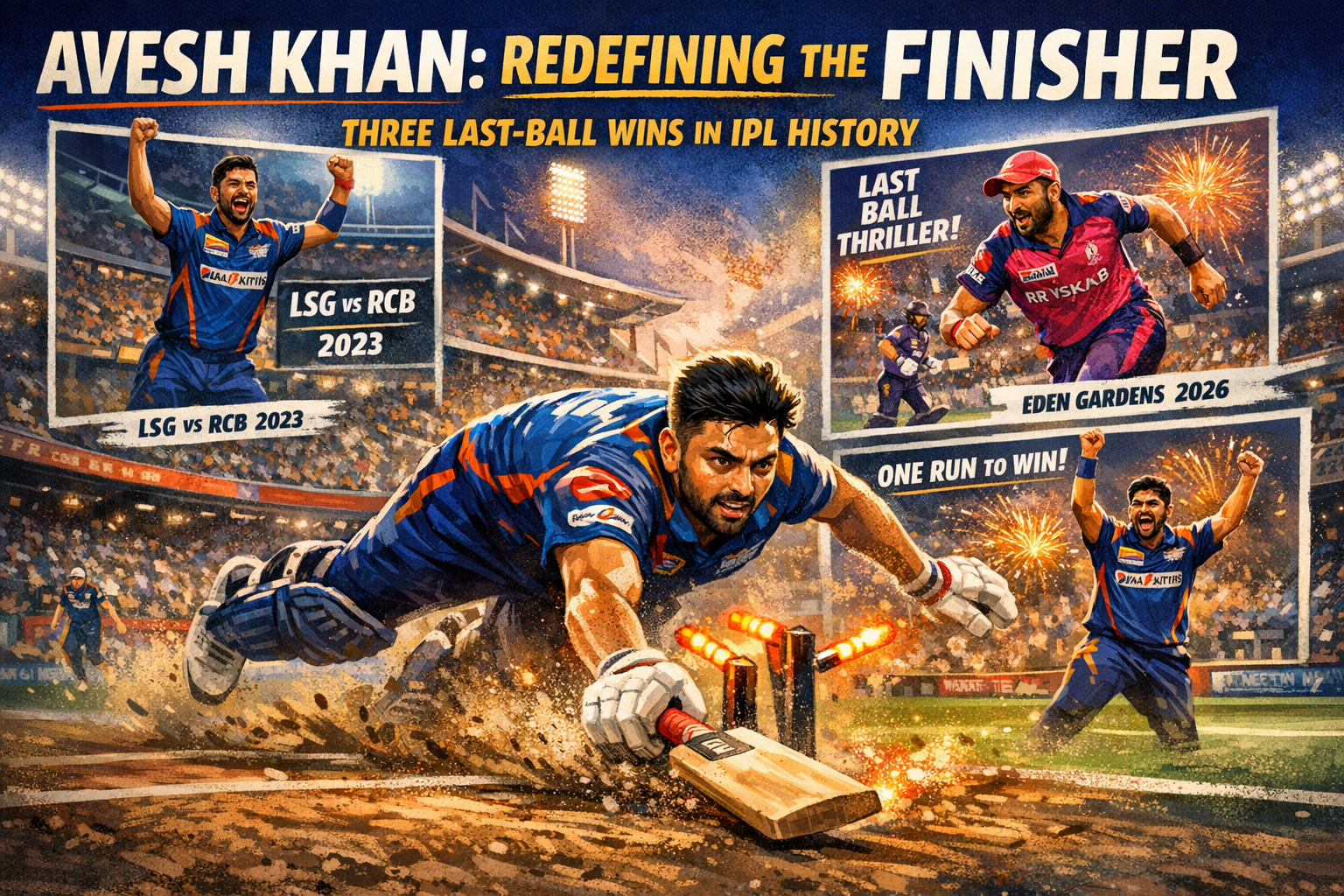
Three times in high-pressure IPL finales, with everything reduced to a single ball and a single run, one figure stood at the non-striker's end and delivered: Avesh Khan. Not with power hitting or a boundary, but with composure, running ability, and an almost absurd knack for being in exactly the right place at the right moment. The pattern spans three seasons — 2023, 2024, and 2026 — and two different franchises, making it one of the more unusual footnotes in recent IPL folklore.
Three Last-Ball Wins, One Common Thread
In IPL 2023, Lucknow Super Giants faced Royal Challengers Bengaluru at the Chinnaswamy Stadium. Chasing 213, LSG had stumbled to 23 for 3 before half-centuries from Marcus Stoinis and Nicholas Pooran hauled the innings back into contention. Ayush Badoni contributed a vital 30. With one run needed off the final delivery, Harshal Patel attempted to dismiss Ravi Bishnoi at the non-striker's end before releasing the ball — and missed. Avesh Khan, facing the ball, made no contact either, but sprinted sharply to collect the byes and complete the winning run. Technically, he scored zero. Effectively, he won the contest.
In IPL 2024, Avesh was representing Rajasthan Royals against Kolkata Knight Riders — a side that had posted 223 for 6, propelled by a century from Sunil Narine. Avesh had taken two wickets in that innings. In the chase, Jos Buttler carried his side deep into the contest, receiving support from Riyan Parag and Rovman Powell before the equation collapsed onto the final ball. Buttler clipped a delivery to the leg side and completed a single — but the run that sealed the victory was run by Avesh Khan, who had not faced a single delivery in the entire innings. The winning contribution was measured entirely in footwork.
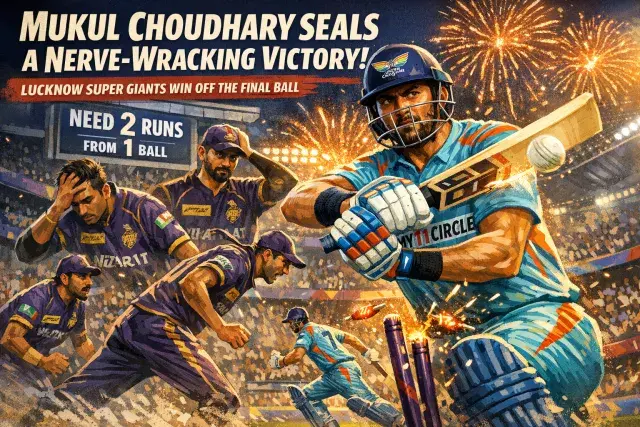
In IPL 2026, back with Lucknow Super Giants, the setting was Eden Gardens. KKR had posted 181. LSG's upper order struggled, but Mukul Choudhary and Ayush Badoni steadied the innings at a critical stage. When the final ball arrived, LSG needed one run, with Mukul Choudhary on strike and Avesh Khan at the other end. Mukul missed the delivery completely. Avesh ran. One run. LSG won. This time, unlike in 2023, the run was officially credited to him.
What This Pattern Actually Reveals
There is a temptation to treat this as mere coincidence — a quirky statistical overlap across three seasons. But it points to something more deliberate about how Avesh Khan performs under pressure. In each instance, the situation demanded not aggression or batting craft, but clarity of decision-making in a fraction of a second. Running between the wickets at the end of a high-stakes final over, when the fielding side is at maximum intensity and the fielders are positioned to cut off exactly such opportunities, requires both physical speed and mental composure. Avesh has demonstrated both, repeatedly.
He is, first and foremost, a pace bowler of genuine quality. His ability to deliver at the death with control and variation has established his value to any side. That his name also appears at the centre of three last-ball victories — none of which involved him being the designated finisher or even the primary batter — is a reminder that contributions in high-pressure situations do not always conform to expected shapes. A fielder who holds a catch at a crucial moment, a runner who converts a bye into a winning run: these contributions rarely make headlines but frequently determine outcomes.
The Understated Value of Calm Under Pressure
The broader significance of Avesh Khan's role in these three finishes is what it says about lower-order composure. In high-stakes final overs, the pressure on a tail-ender at the non-striker's end is far greater than it appears. There is the instinct to protect the strike, the fear of a run-out, and the mental weight of knowing that a mistake at that moment ends everything. Avesh has not flinched across three separate occasions — two franchises, three seasons, three different sets of conditions and opponents.
This consistency is not incidental. It reflects a temperament that translates beyond bowling. The ability to remain present and sharp when the moment demands it, whether with the ball in hand or the bat, is a quality that franchises prize but rarely receive from their lower-order bowlers. Avesh Khan, it turns out, carries it in both roles.